
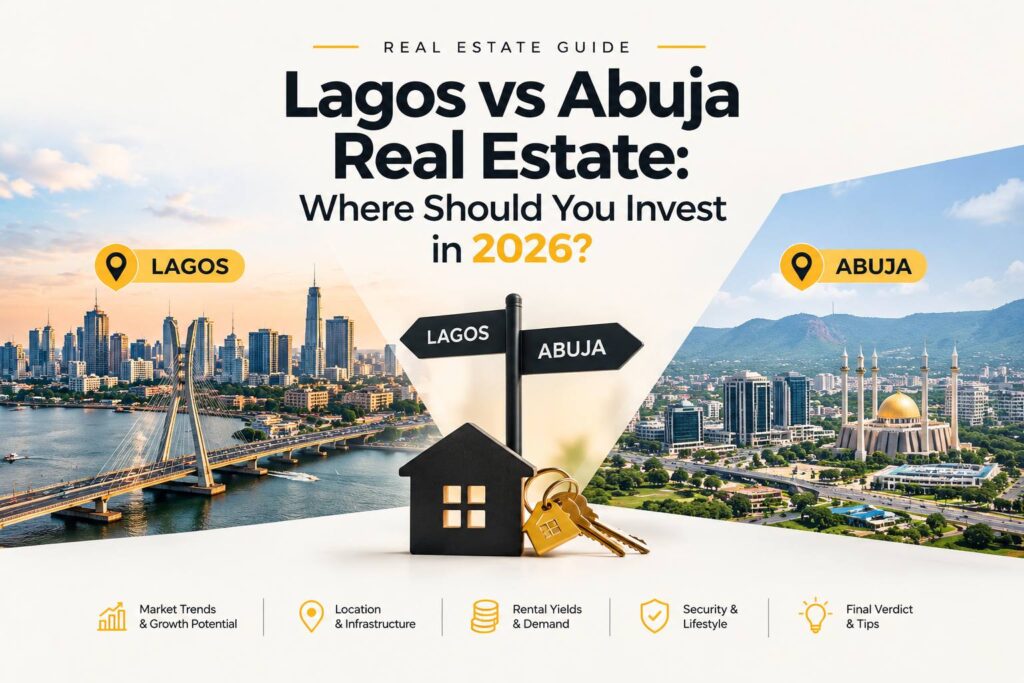
I get this question at least once a week, and it almost always comes with the same nervous energy: “Dare, if you had to put your money in one city right now, Lagos or Abuja?”
It’s a fair question, and it deserves a real answer not the lazy “both are good” that most agents give you when they don’t want to commit to anything. Having sold and managed property in both cities, I can tell you the honest truth: Lagos and Abuja are not competing for the same investor. They reward two completely different strategies, and the city that’s “better” depends entirely on what you’re actually trying to do with your money.
Let’s break it down properly, with real numbers, so you can make this decision with your eyes open.
The Short Answer, If You’re in a Hurry
Lagos is the play if you want higher rental income, faster liquidity, and you’re comfortable doing the extra title diligence that Lagos land demands. Abuja is the play if you want a calmer, more predictable market, cleaner land documentation through the government’s digital registry, and you’re building long-term, generational wealth rather than chasing cash flow. Most of our serious clients eventually own in both but if you can only start with one, keep reading.
How Prices Actually Compare in 2026
Nominal prices in both cities have climbed hard over the last few years — in prime districts of Lagos and Abuja, we’re looking at properties trading roughly 30–60% above where they sat back in 2021/2022. But the two markets price very differently once you look past the headline number:
| Metric | Lagos | Abuja |
|---|---|---|
| Typical 2-bed rent (prime area) | ₦8m – ₦12m/year | ₦1.2m – ₦1.8m/year |
| Typical 5-bed detached rent (top district) | Varies widely by estate | ₦10m+/year in Maitama/Asokoro |
| Price-to-rent ratio (years to “pay back” via rent) | ~27 years | ~23 years |
| Land title system | State registry, informal claims common | Centralised digital cadastre (AGIS) |
| Best buyer profile | Cash-flow and appreciation investors | Stability-focused, long-term holders |
That price-to-rent gap matters more than most buyers realize. It tells you Abuja rent, relative to purchase price, currently gives you a slightly faster “payback” on paper but Lagos more than makes up for it once you factor in short-let income, which we’ll get to.
Rental Yields: Where Your Money Actually Works Harder
This is where Lagos pulls ahead for most of our clients. Mainland hubs like Yaba, Surulere, Gbagada and Ikeja GRA are consistently producing gross yields in the 8–12% range, especially on well-located 1 and 2-bedroom units, smaller units almost always out-yield the big 4 and 5-bedroom houses, because tenant demand is deepest at the compact end of the market. Lekki Phase 1 and Victoria Island add a shortlet layer on top of that: a well-run shortlet apartment can out-earn a standard annual-rent lease by a wide margin if you’re willing to manage (or outsource) the operations.
Abuja yields are more modest typically 5–8% gross across upscale districts like Maitama, Asokoro, Wuse and Jabi. What you’re buying with that lower yield is stability: government, diplomatic, NGO and corporate tenants who sign longer leases, pay reliably, and don’t churn every 12 months. If your priority is a quiet, low-drama income property you don’t have to think about often, that trade-off is worth it for a lot of people.
Land Title Risk: The Conversation Nobody Wants to Have
I’ll be blunt, because this is the part that has burned more Nigerian investors than any market downturn ever has (see my full land scam verification checklist for the exact process): Lagos land titling is messier than Abuja’s. Land disputes, overlapping claims, and “omo-onile” family issues are real risks in parts of Lagos, and they’re exactly why we run every plot through our own verification process before it ever reaches a client checking the Lagos State Land Registry, the survey history, and the chain of ownership before any money changes hands.
Abuja, by contrast, runs land allocation through a centralized digital cadastre (AGIS) under the FCT administration. It doesn’t make Abuja land free of risk acquisition costs are high and paperwork can still move slowly but the structure itself is cleaner and harder to dispute. If title security is your number one concern, that’s a real point in Abuja’s favor.
Growth Corridors Worth Watching in Each City
In Lagos, the money is moving east. The Lekki Free Trade Zone, the Dangote Refinery, and the proposed Lekki International Airport are pulling demand and prices further along the Lekki-Epe corridor every year. Ibeju-Lekki has already re-rated hard; Epe is where that same story is starting from a much lower entry price today.
In Abuja, the growth story is less explosive but steady satellite districts like Lugbe, Kuje and parts of the Airport Road axis are absorbing the overflow demand from central Abuja’s high prices, while Maitama and Asokoro remain the safe-haven core for buyers who simply want the best address and don’t mind paying for it.
Who Should Invest in Lagos
- You want the highest realistic rental income, especially through shortlets or compact apartments
- You’re comfortable paying for proper title verification as the cost of doing business
- You want exposure to Nigeria’s fastest-appreciating growth corridors (Epe, Ibeju-Lekki)
- You want to be able to sell relatively quickly if your plans change Lagos has the deepest, most liquid resale market in the country
Who Should Invest in Abuja
- You want a calmer market with less day-to-day drama
- Clean, verifiable title matters more to you than squeezing out the last point of yield
- You’re building a long-hold, generational asset rather than an active income property
- You value tenants who are government-linked, diplomatic, or corporate and the lease stability that comes with them
My Honest Take
If you’re asking me to pick one for a first-time investor with a single budget, I’ll usually point you to Lagos the yields are better, the resale market is deeper, and if you work with people who actually verify title properly, the extra risk is manageable, not scary. But if you already have Lagos exposure and you’re looking to diversify into something steadier, Abuja earns its place in your portfolio. This isn’t an either/or for most of our clients it’s a sequencing question. Start where the numbers work hardest for your specific goal, then expand.
Frequently Asked Questions
Is Abuja land really safer than Lagos land?
On paper, yes, Abuja’s digital cadastre reduces the risk of overlapping claims. But “safer system” doesn’t mean “no diligence needed.” We still verify every Abuja plot before a client commits.
Which city gives better returns for a diaspora investor who won’t be around to manage the property?
Abuja is often easier to manage remotely because tenant turnover is lower and leases run longer. Lagos can out-earn it, but shortlet-style income needs active or outsourced management.
Is now a good time to buy in either city?
Both markets have risen sharply in nominal naira terms over the past few years, but demand still outstrips supply nationally — Nigeria’s housing deficit runs into the millions of units. For a well-located, properly titled property, timing matters less than title quality and location.
Can Dnovaaproperties help me buy in both cities?
Yes — we operate across Lagos, Abuja, Ogun and Oyo, using the same verification standard everywhere we sell.
If you’re also factoring in the real cost of renting there first, see my breakdown of Abuja’s hidden rental costs.
If you’re weighing this decision for your own money right now, don’t guess message me directly on WhatsApp with your budget and goal (income vs. long-term hold), and I’ll point you to the specific listings that actually fit, in whichever city makes sense for you.